Defence City: The State Tax Service Systematises the Rules for Applying Tax Incentives
Contents
What Has Changed
On 11 August 2026, the State Tax Service of Ukraine published Information Letter No. 3/2026, providing detailed guidance on the practical application of tax incentives available to Defence City residents. The document covers corporate income tax, land tax, real estate tax and environmental tax, as well as transfer pricing, CFC rules, tax audits and compliance with residency requirements.
The preferential regime was introduced by Law No. 4577-IX, which entered into force on 5 October 2025. At the same time, each tax incentive is subject to its own specific conditions. In particular, land and real estate tax incentives apply only to certain land plots and properties defined by law and depend on how they are used.
For defence businesses, this marks an important transition from the general legislative framework of Defence City to a clearer model for its practical application. At the same time, the State Tax Service expressly notes that the Information Letter is for informational purposes only and does not constitute an individual tax ruling.
How the Corporate Income Tax Exemption Will Work
One of the key Defence City incentives is the possibility for a resident’s profit to be exempt from corporate income tax, subject to compliance with the statutory requirements and the subsequent use of such profit for permitted purposes.
Defence City resident status alone is not sufficient. A company must submit an application for the exemption to the competent tax authority at its place of registration. If the tax authority does not issue a refusal within 10 business days after receiving the application, the application is deemed accepted. The exemption applies from the first day of the first month of the calendar quarter following the quarter in which the application was submitted.
To benefit from the exemption, the company must also maintain its Defence City resident status throughout the relevant period, must not be a Diia City resident, must not accrue or distribute dividends to holders of corporate rights except for the specific state-related exemptions provided by law, and must not have established violations of reporting and documentation obligations relating to transfer pricing and CFC rules.
Tax-exempt profit must be used for business development no later than 31 December of the year following the relevant reporting year. Permitted uses include establishing and upgrading the company’s technical and production base, acquiring, modernising, restoring and repairing fixed assets, constructing production and technological facilities, improving production processes, implementing new technologies, acquiring intellectual property rights for the performance of a state defence procurement contract, and financing research and the production of new weapons and military equipment or their components. Profit may also be used to acquire corporate rights in defence industry companies, including through contributions to their share capital, subject to additional conditions regarding the non-distribution of dividends by such companies.
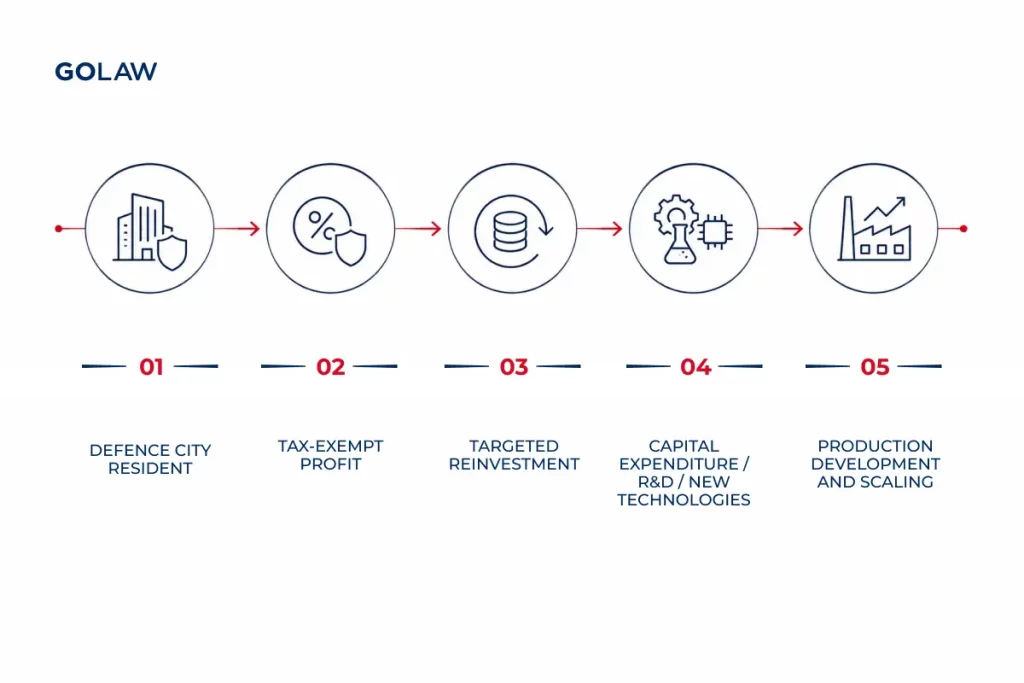
In practice, proper documentation becomes critical. To substantiate the permitted use of tax-exempt profit, a resident should maintain appropriate primary, payment, accounting and corporate documentation. Such documents should confirm the specific purpose for which the funds were used, the economic substance of the transaction and its connection with the Defence City resident’s business activities. Control over the use of tax-exempt profit is carried out in accordance with a separate procedure approved by the Cabinet of Ministers of Ukraine.
What This Means for Businesses and Investors
The key takeaway for Defence City residents is that the tax efficiency of the regime depends not so much on obtaining resident status as on the company’s ability to demonstrate compliance with all conditions of the exemption throughout the entire period of its application.
If tax-exempt profit, or part of it, is not used within the prescribed period for purposes permitted by law, corporate income tax must be accrued and paid on the unused amount. At the same time, using such profit for purposes not permitted by law constitutes improper use.
More significant consequences may arise if a company loses its Defence City status or breaches other conditions applicable to the exemption. In such cases, the company loses the right to the exemption from the beginning of the relevant reporting period and must file an amended tax return, accrue tax and pay interest. If resident status is lost, the amended return must be filed within 30 calendar days. In the case of another breach of the exemption conditions, the amendment must be filed no later than the following day. Importantly, the statutory limitation periods under Article 102 of the Tax Code do not apply to the relevant tax liabilities and interest.
For this reason, in our view, Defence City is becoming a separate area of tax due diligence in investment and M&A transactions. An investor should review not only whether a company holds Defence City resident status, but also when the tax exemption started to apply, whether the applicable conditions have been complied with, whether the tax-exempt profit has been correctly calculated, how it has been used historically, and whether the supporting documentation is sufficient. If breaches are identified, the expected tax benefit of the regime may prove less sustainable than the company’s formal resident status would suggest.
International structures require separate attention. Defence City does not disapply transfer pricing rules. A resident carrying out controlled transactions must separately determine the taxable amount resulting from adjustments under the arm’s length principle, and such adjustments are not covered by the corporate income tax exemption. Likewise, adjusted CFC profit is not included in the profit eligible for the Defence City exemption and is taxed under the general rules.
The tax debt requirement should also be understood correctly. The law does not impose an absolute prohibition on any amount of outstanding tax liability. A company is ineligible for Defence City residency if its aggregate tax debt and/or unified social security contribution arrears exceed 10 minimum monthly wages, calculated based on the minimum wage as of 1 January of the relevant year. This requirement must be met throughout the entire period of residency, as failure to comply with the statutory residency criteria may result in loss of Defence City status.
What Companies Should Do Now
Companies that are already Defence City residents or plan to use the available tax incentives should establish an internal control process in advance. This should include separate analytical accounting for tax-exempt profit, proper documentation of decisions concerning capital expenditure and R&D, control over the timing and permitted uses of reinvestment, review of transfer pricing and CFC matters, and regular monitoring of tax arrears. Companies preparing to raise investment or enter into an M&A transaction should also conduct a retrospective review of the entire period during which the preferential regime has been applied.
The importance of such preparation is also increasing from a reporting perspective. The corporate income tax return form has already been amended by Order of the Ministry of Finance No. 249 to reflect the Defence City rules, including the reporting of tax liabilities and interest arising from breaches of the regime conditions or loss of resident status. The State Tax Service has confirmed that the updated return form will apply for the three-quarter reporting period of 2026.
At GOLAW, we assist defence companies with comprehensive reviews of their use of the Defence City regime, structuring the use and reinvestment of tax-exempt profit, analysing transfer pricing, CFC and other tax risks, and preparing businesses for investment and M&A transactions. For companies planning to benefit from the Defence City incentives, now is a good time to confirm that their tax model is supported not only by its expected economic effect, but also by a sound legal and documentary framework.

Oleksandr Melnyk
Partner, Head of Corporate Law and M&A practice, Attorney at law
- Contacts
- 31/33 Kniaziv Ostrozkykh St, Zorianyi Business Center, Kyiv, Ukraine, 01010
- o.melnyk@golaw.ua
- +38 044 581 1220
- Recognitions
- Lexology Index: Client Choice 2026
- The Legal 500 2025
- IFLR1000 2025 (International Financial Law Review)
- Legal 500 Green Guide 2024
- 50 Leading Law Firms Ukraine 2026

Viktoriia Bublichenko
Partner, Head of Tax, Restructuring, Claims and Recoveries practice, Attorney at law
- Contacts
- 31/33 Kniaziv Ostrozkykh St, Zorianyi Business Center, Kyiv, Ukraine, 01010
- v.bublichenko@golaw.ua
- +38 044 581 1220
- Recognitions
- ITR World Tax 2026
- Lexology Index: Corporate Tax 2025
- IFLR 1000 2024
- 50 Leading Law Firms Ukraine 2026
Get in touch
To get a consultation, please fill out the form below or call us right away:
 We respond within 2 hours on business days
31/33 Kniaziv Ostrozkykh st, Kyiv
We respond within 2 hours on business days
31/33 Kniaziv Ostrozkykh st, Kyiv
 All data is protected by attorney-client privilege in accordance with Article 22 of the Law of Ukraine “On the Bar and the Practice of Law.”



Sign up to be aware
New achievements are inspired by information. GO further, don’t miss out GOLAW news and legal alerts
We use cookies to improve performance of our website and your user experience.
Cookies policy
Cookies settings


